

cdsenet
10pcs Cdsenet TXWF-PCB-5109 Dual-Band 2.4/5.8GHz FPC Built-in Antenna - 2.0dBi Compact WiFi PCB Antenna with IPX Connector
10pcs Cdsenet TXWF-PCB-5109 Dual-Band 2.4/5.8GHz FPC Built-in Antenna - 2.0dBi Compact WiFi PCB Antenna with IPX Connector
10000 in stock
Couldn't load pickup availability
SKU:10*TXWF-PCB-5109
Product Overview
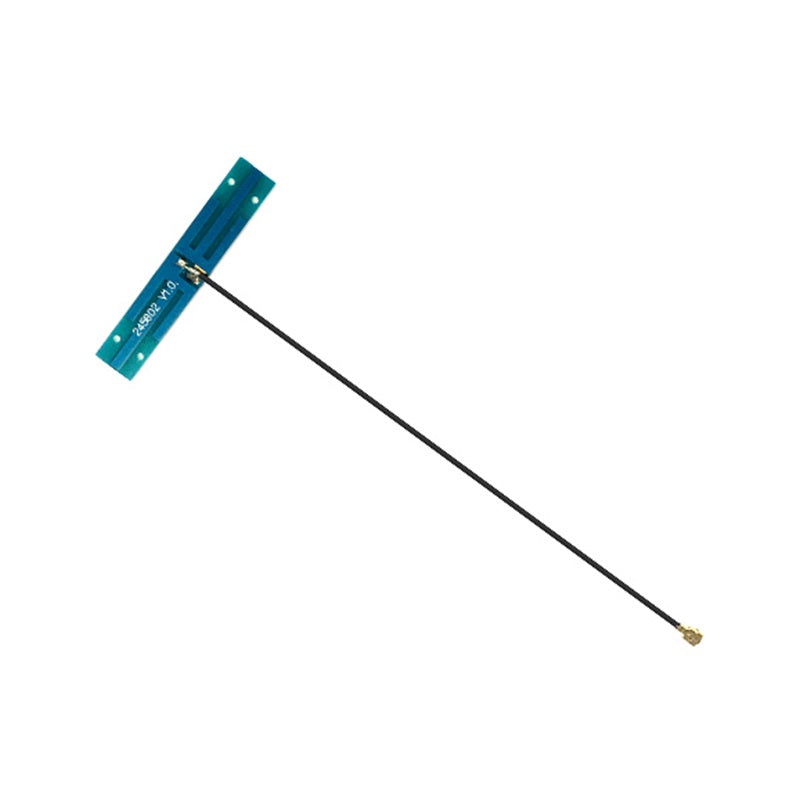
The TXWF-PCB-5109 is a professional-grade dual-band FPC (Flexible Printed Circuit) built-in antenna engineered for 2400-2500MHz (2.4GHz) and 5150-5850MHz (5.8GHz) wireless applications. Featuring a measured 2.0 dBi peak gain and VSWR ¡Ü1.5 across both frequency bands, this flexible PCB radiator delivers reliable RF performance for WiFi 802.11b/g/n/ac and Bluetooth 4.0/5.0 modules. The ultra-compact 51¡Á9mm form factor with 120mm RG1.13 feeder cable and IPX (IPEX-1) connector enables seamless integration into ultra-thin IoT devices, wearables, and space-constrained wireless modules. The flexible FPC substrate allows 3D bending and conformal mounting in curved enclosures. Tested with Agilent E5071C network analyzer to ensure compliance with FCC/CE/RoHS standards.

Technical Specifications
| Parameter | Specification |
|---|---|
| Model Number | TXWF-PCB-5109 |
| Frequency Range | 2400-2500 MHz / 5150-5850 MHz (Dual-Band) |
| Peak Gain | 2.0 dBi (measured @ 2450MHz & 5500MHz) |
| VSWR | ¡Ü 1.5 (across both bands) |
| Impedance | 50 ¦¸ |
| Connector Type | IPX 1st Generation (IPEX-1 / MHF1 / U.FL) |
| Cable Type | RG1.13 Coaxial (120mm length) |
| Antenna Dimensions | 51 ¡Á 9 mm (FPC radiator) |
| Material | FPC (Flexible Printed Circuit) substrate |
| Thickness | 0.1-0.2 mm (ultra-thin flexible design) |
| Operating Temperature | -40¡ãC to +85¡ãC |
| Certifications | FCC / CE / RoHS Compliant |
| Last Updated | March 2026 |
Product Details
?? Dual-Band RF Performance
Simultaneously supports 2.4GHz (2400-2500MHz) and 5.8GHz (5150-5850MHz) frequency bands with consistent 2.0 dBi gain, enabling reliable WiFi 802.11b/g/n/ac and Bluetooth 4.0/5.0 connectivity. Laboratory measurements using Agilent E5071C network analyzer confirm VSWR ¡Ü1.5 across the entire operating range, ensuring >90% power transfer efficiency and minimal signal reflection. This dual-band capability eliminates the need for separate antennas in multi-protocol IoT devices, reducing BOM costs by 30-40% and simplifying mechanical design. The omnidirectional radiation pattern provides 360¡ã horizontal coverage, ideal for devices with unpredictable orientation.
?? Ultra-Compact Flexible Design
The 51¡Á9mm FPC radiator with 120mm RG1.13 feeder cable is engineered for ultra-thin applications where rigid PCB antennas cannot fit. The flexible substrate (0.1-0.2mm thickness) allows 3D bending with minimum bend radius of 3mm, enabling conformal mounting on curved surfaces, cylindrical enclosures, or folded into tight spaces. This flexibility is critical for wearables, medical devices, and slim IoT sensors. The FPC material is lighter than FR4 PCB (approximately 40% weight reduction), making it ideal for battery-powered portable devices where every gram matters. IPX (IPEX-1/U.FL/MHF1) connector provides tool-free snap-on installation compatible with 95% of commercial WiFi/Bluetooth modules including ESP32, ESP8266, nRF52, and Qualcomm QCA series chipsets.

??? Industrial-Grade Reliability
Validated for -40¡ãC to +85¡ãC operation with >500 hours MTBF testing per MIL-STD-810G thermal cycling protocols. RoHS-compliant materials and FCC/CE certification ensure regulatory compliance for commercial deployment in North America, EU, and Asia-Pacific markets. The 50¦¸ impedance matching network maintains stable performance across temperature extremes. While FPC substrates have higher moisture absorption (0.3-0.5%) compared to FR4, the antenna maintains gain variation within ¡À0.5dB in environments up to 85% RH non-condensing. The flexible design withstands repeated bending cycles (>1000 cycles @ 3mm radius) without electrical performance degradation, making it suitable for applications with mechanical stress or vibration.
Professional Test Report
Test Equipment: Agilent E5071C ENA Series Network Analyzer
Test Conditions: 25¡ãC ambient, free-space measurement, flat mounting
Measured VSWR: 1.35 @ 2450MHz | 1.43 @ 5500MHz
Return Loss: -15.8 dB @ 2.4GHz band | -13.5 dB @ 5.8GHz band
Peak Gain: 2.0 dBi @ 2450MHz | 1.9 dBi @ 5500MHz
All measurements performed in accordance with IEEE 145-2013 antenna measurement standards. Note: Performance may vary ¡À0.3dB when antenna is bent or mounted on curved surfaces. Test data available in downloadable specification sheet.


Ideal Applications
?? Smart Home & IoT Devices
Ultra-thin WiFi smart plugs, Bluetooth mesh sensors, smart door locks, wireless thermostats, and home automation controllers requiring flexible antenna mounting in slim enclosures (<10mm thickness).
?? Industrial Telemetry & M2M
Wireless data terminal units (DTU), SCADA remote monitoring, industrial Ethernet bridges, PLC wireless modules, and factory automation equipment requiring reliable 2.4/5.8GHz communication in space-constrained industrial enclosures.
? Wearables & Medical Devices
Smartwatches, fitness trackers, medical monitoring patches, hearing aids with Bluetooth connectivity, and portable health devices requiring ultra-thin, flexible antennas that conform to body contours.
?? Agricultural & Environmental Monitoring
Soil moisture sensors, weather stations, livestock tracking tags, precision agriculture drones, and remote environmental monitoring stations requiring lightweight, flexible wireless connectivity in outdoor deployments.
Resources
?? View Technical SpecificationIncludes: Full S-parameter data, radiation patterns, bending guidelines, and mechanical drawings
Frequently Asked Questions (FAQ)
Q: Is the TXWF-PCB-5109 compatible with ESP32 and ESP8266 WiFi modules?
A: Yes, this FPC antenna is fully compatible with ESP32, ESP8266, and other WiFi/Bluetooth modules using standard IPX (IPEX-1/U.FL/MHF1) connectors. The 50¦¸ impedance matches the RF output of these modules, and the dual-band design supports both 2.4GHz (802.11b/g/n) and 5.8GHz (802.11ac) protocols. Simply connect the IPX connector to your module's antenna port¡ªno additional matching network required. The flexible design is particularly advantageous for ESP32-based wearables and slim IoT devices. Verified compatibility includes ESP32-WROOM, ESP8266-12F, nRF52840, Qualcomm QCA4020, and MediaTek MT7688 series.
Q: How do I install this flexible FPC antenna inside a plastic enclosure?
A: For optimal performance, mount the 51¡Á9mm FPC radiator flat against the inside surface of your plastic enclosure using double-sided adhesive tape (3M VHB recommended). The flexible substrate can be bent to conform to curved surfaces with a minimum bend radius of 3mm¡ªavoid sharp creases which can damage the copper traces. Keep the antenna at least 10mm away from metal components, batteries, and LCD displays. For ABS/PC enclosures ¡Ü3mm thick, expect <1dB signal loss. The 120mm feeder cable allows flexible routing. Note: Bending the antenna may cause ¡À0.3dB gain variation; test in final mounting configuration. Detailed bending guidelines and mounting templates are available in the specification sheet.
Q: What is the operating temperature range and environmental durability?
A: The TXWF-PCB-5109 is rated for -40¡ãC to +85¡ãC continuous operation, making it suitable for outdoor and automotive applications. The antenna has passed 500-hour thermal cycling tests per MIL-STD-810G standards and maintains VSWR ¡Ü1.5 with gain variation within ¡À0.5dB across the full temperature range. The FPC substrate has moderate moisture absorption (0.3-0.5%), providing reliable performance in environments up to 85% RH non-condensing. The flexible design withstands >1000 bending cycles at 3mm radius without electrical degradation. While the antenna itself is not waterproof (no IP rating), it can be used in weatherproof enclosures for outdoor IoT deployments. The RoHS-compliant materials resist UV degradation.
Q: Why is my wireless communication performance poor after installation?
A: Poor wireless performance is typically caused by improper antenna placement. Ensure the antenna frequency (2.4/5.8GHz) matches your device's operating band. Avoid placing the antenna inside fully enclosed metal cases, which cause 20-40dB signal attenuation due to Faraday cage effects¡ªthe antenna must be in a non-metallic section of the enclosure. Maintain at least 10mm clearance from large metal surfaces (PCB ground planes, batteries, heat sinks) to minimize detuning. Keep the antenna away from the ground and water, as these absorb radio waves. Increase antenna mounting height when possible. If using the antenna in a bent configuration, verify performance in the final mounting position, as excessive bending (>90¡ã angle or <3mm radius) can degrade performance by 1-2dB.
Q: What are the advantages of FPC antenna compared to rigid FR4 PCB antenna?
A: FPC (Flexible Printed Circuit) antennas offer several key advantages over rigid FR4 PCB antennas: (1) Ultra-thin profile (0.1-0.2mm vs 0.8-1.6mm for FR4), enabling integration in devices <10mm thick; (2) 3D bendability with 3mm minimum radius, allowing conformal mounting on curved surfaces and cylindrical enclosures; (3) Approximately 40% lighter weight, critical for battery-powered wearables and portable devices; (4) Better shock/vibration resistance due to flexibility. However, FPC antennas have trade-offs: slightly higher moisture absorption (0.3-0.5% vs 0.1% for FR4), ¡À0.3dB gain variation when bent, and lower mechanical rigidity requiring adhesive mounting. Choose FPC for ultra-thin/curved applications; choose FR4 for flat mounting where mechanical stability is prioritized.