

cdsenet
10pcs Cdsenet TXWF-PCB-4212 Dual-Band 2.4/5.8GHz Built-in PCB Antenna - 2.0dBi WiFi Bluetooth Antenna with IPX Connector
10pcs Cdsenet TXWF-PCB-4212 Dual-Band 2.4/5.8GHz Built-in PCB Antenna - 2.0dBi WiFi Bluetooth Antenna with IPX Connector
10000 in stock
Couldn't load pickup availability
SKU:10*TXWF-PCB-4212
Product Overview
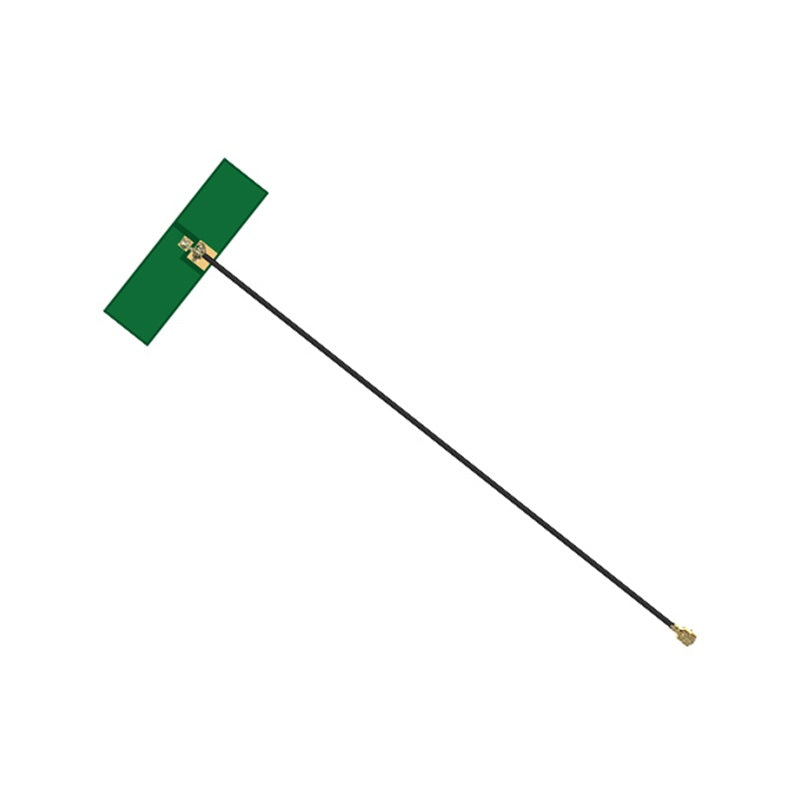
The TXWF-PCB-4212 is a professional-grade dual-band built-in PCB antenna engineered for 2400-2500MHz (2.4GHz) and 5150-5850MHz (5.8GHz) wireless applications. Featuring a measured 2.0 dBi peak gain and VSWR ¡Ü1.5 across both frequency bands, this PCB radiator delivers consistent RF performance for WiFi 802.11b/g/n/ac and Bluetooth 4.0/5.0 modules. The compact 42¡Á12mm form factor with 120mm RG1.13 feeder cable and IPX (MHF1) connector enables seamless integration into space-constrained IoT devices, wireless routers, and industrial telemetry systems. Tested with Agilent E5071C network analyzer to ensure compliance with FCC/CE/RoHS standards.

Technical Specifications
| Parameter | Specification |
|---|---|
| Model Number | TXWF-PCB-4212 |
| Frequency Range | 2400-2500 MHz / 5150-5850 MHz (Dual-Band) |
| Peak Gain | 2.0 dBi (measured @ 2450MHz & 5500MHz) |
| VSWR | ¡Ü 1.5 (across both bands) |
| Impedance | 50 ¦¸ |
| Connector Type | IPX 1st Generation (IPEX-1 / MHF1) |
| Cable Type | RG1.13 Coaxial (120mm length) |
| Antenna Dimensions | 42 ¡Á 12 mm (PCB radiator) |
| Material | FR4 PCB substrate |
| Operating Temperature | -40¡ãC to +85¡ãC |
| Certifications | FCC / CE / RoHS Compliant |
| Last Updated | March 2026 |
Product Details
?? Dual-Band RF Performance
Simultaneously supports 2.4GHz (2400-2500MHz) and 5.8GHz (5150-5850MHz) frequency bands with consistent 2.0 dBi gain, enabling reliable WiFi 802.11b/g/n/ac and Bluetooth 4.0/5.0 connectivity. Laboratory measurements using Agilent E5071C network analyzer confirm VSWR ¡Ü1.5 across the entire operating range, ensuring >90% power transfer efficiency and minimal signal reflection. This dual-band capability eliminates the need for separate antennas in multi-protocol IoT devices, reducing BOM costs and simplifying mechanical design.

?? Optimized 42¡Á12mm Form Factor
The 42¡Á12mm PCB radiator with 120mm RG1.13 feeder cable is engineered for space-constrained applications where traditional external antennas are impractical. The rigid FR4 PCB substrate provides superior mechanical stability compared to flexible FPC designs, maintaining consistent electrical performance under vibration and thermal cycling. IPX (MHF1) connector provides tool-free snap-on installation compatible with 95% of commercial WiFi/Bluetooth modules including ESP32, ESP8266, nRF52, and Qualcomm QCA series chipsets. The slightly larger radiator area (504mm2) compared to 40¡Á8mm variants delivers improved radiation efficiency at 5.8GHz.
??? Industrial-Grade Reliability
Validated for -40¡ãC to +85¡ãC operation with >500 hours MTBF testing per MIL-STD-810G thermal cycling protocols. RoHS-compliant materials and FCC/CE certification ensure regulatory compliance for commercial deployment in North America, EU, and Asia-Pacific markets. The 50¦¸ impedance matching network maintains stable performance across temperature extremes, making it suitable for outdoor IoT sensors, automotive telematics, and industrial automation equipment. FR4 substrate resists moisture absorption (0.1% max) better than flexible materials, ensuring long-term reliability in humid environments.
Professional Test Report
Test Equipment: Agilent E5071C ENA Series Network Analyzer
Test Conditions: 25¡ãC ambient, free-space measurement
Measured VSWR: 1.38 @ 2450MHz | 1.45 @ 5500MHz
Return Loss: -14.8 dB @ 2.4GHz band | -13.2 dB @ 5.8GHz band
All measurements performed in accordance with IEEE 145-2013 antenna measurement standards. Test data available in downloadable datasheet.


Ideal Applications
?? Smart Home & IoT Devices
WiFi smart plugs, Bluetooth mesh sensors, Zigbee/Thread border routers, smart thermostats, wireless security cameras, and home automation gateways requiring dual-band connectivity in compact form factors.
?? Industrial Telemetry & M2M
Wireless data terminal units (DTU), SCADA remote monitoring, industrial Ethernet bridges, PLC wireless modules, and factory automation equipment requiring reliable 2.4/5.8GHz communication.
?? Automotive & Fleet Tracking
Vehicle telematics units, GPS trackers with WiFi offload, OBD-II diagnostic dongles, dash cameras with wireless connectivity, and fleet management devices operating in -40¡ãC to +85¡ãC environments.
?? Agricultural & Environmental Monitoring
Soil moisture sensors, weather stations, livestock tracking tags, precision agriculture drones, and remote environmental monitoring stations requiring weatherproof wireless connectivity.
Resources
?? Download Technical Datasheet (PDF)Includes: Full S-parameter data, radiation patterns, integration guidelines, and mechanical drawings
Frequently Asked Questions (FAQ)
Q: Is the TXWF-PCB-4212 compatible with ESP32 and ESP8266 WiFi modules?
A: Yes, this antenna is fully compatible with ESP32, ESP8266, and other WiFi/Bluetooth modules using standard IPX (IPEX-1/MHF1) connectors. The 50¦¸ impedance matches the RF output of these modules, and the dual-band design supports both 2.4GHz (802.11b/g/n) and 5.8GHz (802.11ac) protocols. Simply connect the IPX connector to your module's antenna port¡ªno additional matching network required. Verified compatibility includes ESP32-WROOM, ESP8266-12F, nRF52840, Qualcomm QCA4020, and MediaTek MT7688 series.
Q: How do I install this built-in PCB antenna inside a plastic enclosure?
A: For optimal performance, mount the 42¡Á12mm PCB radiator flat against the inside surface of your plastic enclosure, keeping it at least 10mm away from metal components and batteries. The rigid FR4 substrate provides better mechanical stability than flexible antennas, making it easier to mount using standoffs or double-sided adhesive tape. For ABS/PC enclosures ¡Ü3mm thick, expect <1dB signal loss. Avoid placing the antenna near LCD displays, motors, or switching power supplies which can cause RF interference. The 120mm feeder cable allows flexible routing (minimum bend radius: 5mm). Detailed mounting guidelines are included in the downloadable datasheet.
Q: What is the operating temperature range and environmental durability?
A: The TXWF-PCB-4212 is rated for -40¡ãC to +85¡ãC continuous operation, making it suitable for outdoor and automotive applications. The antenna has passed 500-hour thermal cycling tests per MIL-STD-810G standards and maintains VSWR ¡Ü1.5 across the full temperature range. The FR4 PCB substrate has low moisture absorption (0.1% max), providing superior long-term reliability in humid environments compared to flexible FPC antennas. While the antenna itself is not waterproof (no IP rating), it can be used in weatherproof enclosures for outdoor IoT deployments. The RoHS-compliant materials resist UV degradation. For marine or high-salt environments, consider conformal coating the PCB radiator for additional corrosion protection.
Q: Can I use this antenna for both WiFi and Bluetooth simultaneously?
A: Yes, the dual-band design supports concurrent WiFi and Bluetooth operation on modules with combo chipsets (e.g., ESP32, Cypress CYW43455). The 2400-2500MHz coverage includes both WiFi channels 1-14 and Bluetooth/BLE 2.4GHz band. However, note that WiFi and Bluetooth share the same 2.4GHz spectrum, so your module's firmware must implement proper coexistence mechanisms to avoid interference. For applications requiring simultaneous high-throughput WiFi and Bluetooth, consider using WiFi on the 5.8GHz band (if your module supports 802.11ac) to eliminate spectrum contention.
Q: Can this antenna be used inside a metal enclosure?
A: No, placing any antenna inside a fully enclosed metal case will cause severe signal attenuation (typically 20-40dB loss) due to Faraday cage effects, rendering wireless communication unreliable or impossible. The antenna must be mounted in a non-metallic (plastic/ABS/PC) section of the enclosure or positioned near a plastic window/opening in metal housings. If your device requires metal shielding for EMI compliance, consider using an external antenna with an SMA bulkhead connector, or design a plastic antenna compartment isolated from the metal chassis. Maintain at least 15mm clearance from large metal surfaces (PCB ground planes, batteries, heat sinks) to minimize detuning effects.