

cdsenet
Cdsenet TXGN-FPC-3308 NB-IoT GSM FPC Antenna 3.0dBi Dual-Band IPX-I
Cdsenet TXGN-FPC-3308 NB-IoT GSM FPC Antenna 3.0dBi Dual-Band IPX-I
10000 in stock
Couldn't load pickup availability
SKU:txgn-fpc-3308
Product Overview
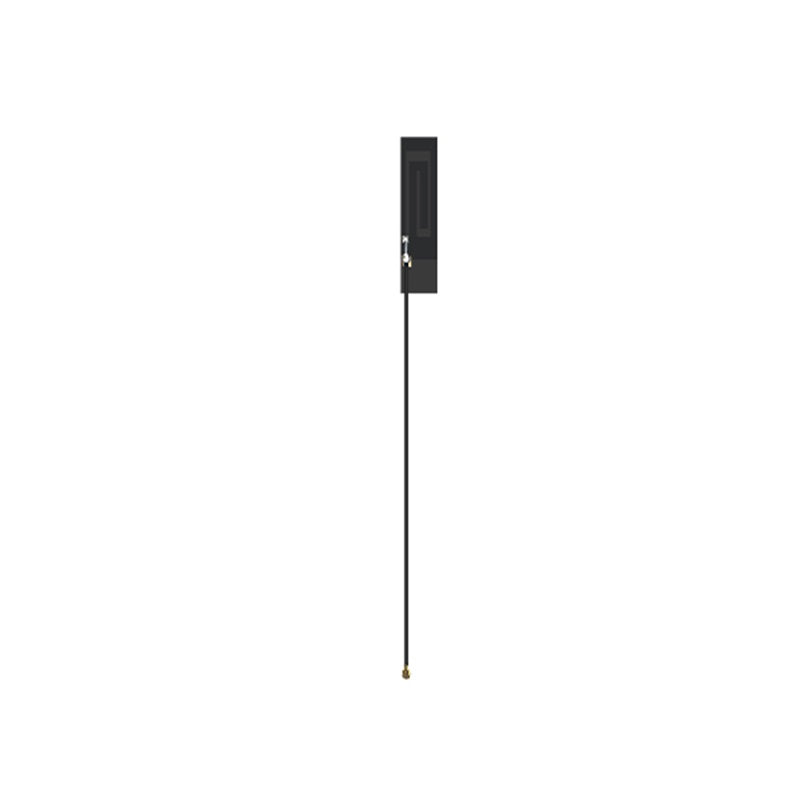
The TXGN-FPC-3308 is an NB-IoT / GSM / GPRS dual-band FPC (Flexible Printed Circuit) internal antenna engineered for compact cellular IoT terminals. It delivers a peak gain of 3.0 dBi with VSWR ≤ 1.5 across two frequency ranges: 824–960 MHz (GSM 850/900, NB-IoT Band 5/8/20/28) and 1710–2170 MHz (GSM 1800/1900, WCDMA Band 1/2/4). The ultra-compact 33 × 8mm FPC radiator with a 95mm IPX-I feeder enables integration into the smallest smart meter, asset tracker, and industrial IoT enclosures where space is the primary constraint. Updated March 2026.

Technical Specifications
| Parameter | Value |
|---|---|
| Frequency Range | 824–960 MHz & 1710–2170 MHz (NB-IoT / GSM / GPRS / WCDMA) |
| Peak Gain | 3.0 dBi |
| VSWR | ≤ 1.5 across both bands (verified with Agilent E5071C) |
| Impedance | 50 Ω |
| Connector Type | IPX-I (IPEX Gen 1 / U.FL compatible) |
| Cable Length | 95 mm (customizable per order) |
| Antenna Dimensions | 33 × 8 mm |
| Radiator Material | FPC (Flexible Printed Circuit) |
| Max Input Power | 50 W |
| Operating Temperature | -40 °C to +85 °C |
| Compliance | RoHS |
| Last Updated | March 2026 |
Product Details
33 × 8mm Ultra-Compact FPC — Smallest-Class NB-IoT Internal Antenna
At just 33 × 8mm, the TXGN-FPC-3308 is designed for enclosures where even standard 45mm FPC antennas cannot fit — including coin-cell-powered NB-IoT sensors, smart utility meters, and miniature asset trackers. The FPC substrate conforms to curved inner surfaces with a 3M adhesive backing, enabling tool-free mounting without modifying the enclosure. Despite its compact size, the antenna achieves 3.0 dBi gain with VSWR ≤ 1.5, meeting the same impedance matching standard as larger sub-1GHz antennas.

IPX-I Connector with 95mm Customizable Feeder
The standard IPX-I (U.FL-compatible) connector mates directly with Quectel BC660K, SIMCom SIM7020, and other NB-IoT / GSM modules. The 95mm coaxial feeder is customizable in length per order, accommodating a wide range of enclosure layouts. Press-fit installation requires no soldering and is compatible with automated assembly lines for high-volume IoT device production.
Professional Test Report
Measured with Agilent E5071C vector network analyzer: VSWR ≤ 1.5 confirmed across both operating bands (824–960 MHz and 1710–2170 MHz). Achieving ≤1.5 VSWR across a dual-band cellular antenna in a 33 × 8mm FPC form factor demonstrates precise radiator tuning for NB-IoT and GSM frequency requirements.


Ideal Applications
NB-IoT Smart Metering
Smart gas, water, and electricity meters using NB-IoT Band 20/28 (Europe) or Band 5/8 (Asia-Pacific) for low-power wide-area cellular uplink without SIM card subscription complexity.
GSM / GPRS Asset Tracking
Logistics tracking devices, cold-chain monitors, and handheld GSM terminals requiring a compact internal antenna with dual-band GSM 850/900/1800/1900MHz coverage.
Environmental & Industrial Sensors
NB-IoT environmental monitoring nodes for air quality, temperature, and humidity in smart buildings, industrial facilities, and agricultural deployments.
Wearables & Compact IoT Devices
Personal emergency response devices, elderly care wearables, and miniature IoT terminals where the 33 × 8mm form factor enables cellular connectivity in the smallest possible enclosure.
Resources
📄 Download Datasheet (PDF)Frequently Asked Questions
Q: Which NB-IoT and GSM bands does the TXGN-FPC-3308 support?
A: The 824–960MHz band covers NB-IoT Band 5 (850MHz, Americas), Band 8 (900MHz, Asia-Pacific/Europe), Band 20 (800MHz, Europe), and Band 28 (700MHz, Asia-Pacific), as well as GSM 850/900MHz. The 1710–2170MHz band covers GSM 1800/1900MHz and WCDMA Band 1/2/4. This dual-band coverage supports global NB-IoT and GSM deployments with a single antenna design.
Q: Is this antenna compatible with LoRa modules?
A: The TXGN-FPC-3308 is optimized for NB-IoT and GSM frequencies (824–960MHz and 1710–2170MHz). While the lower band partially overlaps with 868/915MHz LoRa frequencies, the antenna is not tuned for LoRa impedance matching at those specific frequencies. For LoRa and LoRaWAN applications, use a dedicated 868/915MHz antenna such as the TX915-FPC-4510 for optimal VSWR and gain performance.
Q: Can the 95mm cable length be customized?
A: Yes. The standard cable length is 95mm, but custom lengths are available per order to accommodate specific enclosure layouts. Contact CDSENET with your required cable length and connector type when placing a bulk order. Custom cable lengths do not affect the antenna's RF performance as long as the feeder cable loss at the operating frequency is accounted for in the system link budget.
Q: Can this antenna be installed inside a metal enclosure?
A: No. Placing any FPC antenna inside a metallic housing causes severe signal attenuation due to RF shielding. The TXGN-FPC-3308 must be mounted on the inner surface of a non-metallic (ABS, PC, or TPEE) enclosure with a minimum 5mm clearance from metal components. For metal enclosures, use an external cellular antenna with a bulkhead SMA connector routed through a feedthrough.
Q: What is the operating temperature range and is it suitable for outdoor deployments?
A: The TXGN-FPC-3308 is rated for -40°C to +85°C, covering outdoor industrial and utility meter deployments. The FPC substrate is RoHS-compliant and resistant to humidity under standard operating conditions. For direct outdoor exposure, ensure the host enclosure provides IP65 or higher sealing. The antenna itself is not independently IP-rated and must be protected by the device enclosure.