


cdsenet
10pcs CDSENET TX4G-PCB-6613 4G LTE PCB Antenna 3.0dBi 700-2700MHz IPX-I IoT
10pcs CDSENET TX4G-PCB-6613 4G LTE PCB Antenna 3.0dBi 700-2700MHz IPX-I IoT
100 in stock
Couldn't load pickup availability
SKU:10-TX4G-PCB-6613
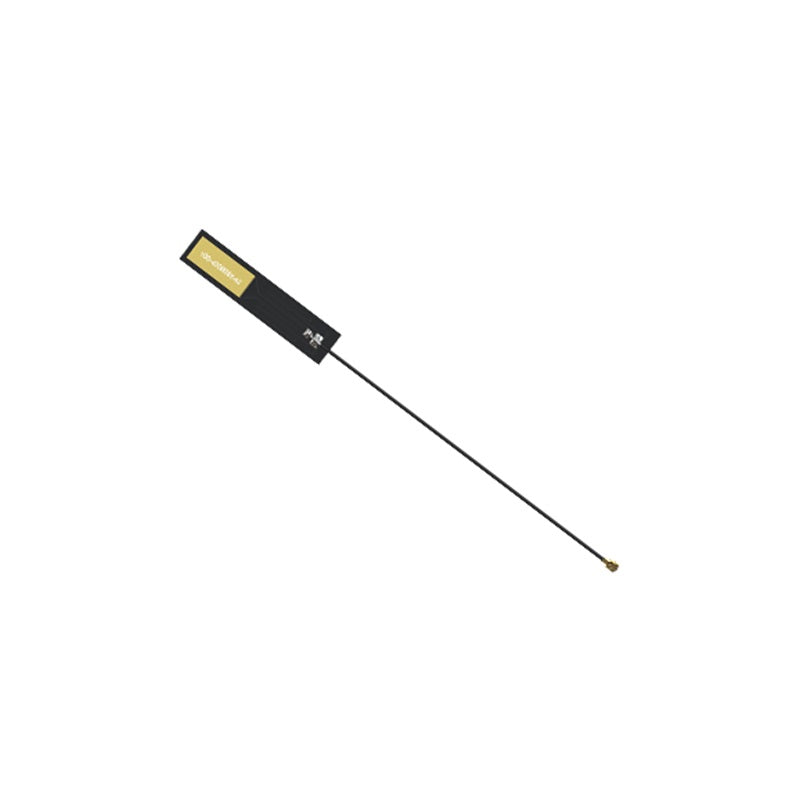


Product Overview
The TX4G-PCB-6613 is a 4G/LTE full-band PCB internal antenna engineered for cellular IoT modules, industrial routers, DTU terminals, and smart payment devices. It delivers a measured peak gain of 3.0 dBi with VSWR ≤ 2.0 across the continuous 700–2700 MHz range, covering LTE, NB-IoT, and LTE-M bands in a single antenna. The 66 × 13mm rigid PCB radiator with a 120mm IPX-I feeder provides a larger aperture than compact 44mm variants, supporting stronger low-band (700–900MHz) performance for improved building penetration. Updated March 2026.

Technical Specifications
| Parameter | Value |
|---|---|
| Frequency Range | 700 – 2700 MHz (4G/LTE full band, NB-IoT, LTE-M) |
| Peak Gain | 3.0 dBi |
| VSWR | ≤ 2.0 across 700–2700 MHz — wideband LTE spec |
| Impedance | 50 Ω |
| Connector Type | IPX-I (IPEX Gen 1 / U.FL compatible) |
| Cable Length | 120 mm (gold-plated connector) |
| Antenna Dimensions | 66 × 13 mm |
| Radiator Material | PCB (Printed Circuit Board, rigid) |
| Polarization | Linear (vertical) |
| Max Input Power | 50 W |
| Operating Temperature | -40 °C to +85 °C |
| Compliance | RoHS |
| Last Updated | March 2026 |
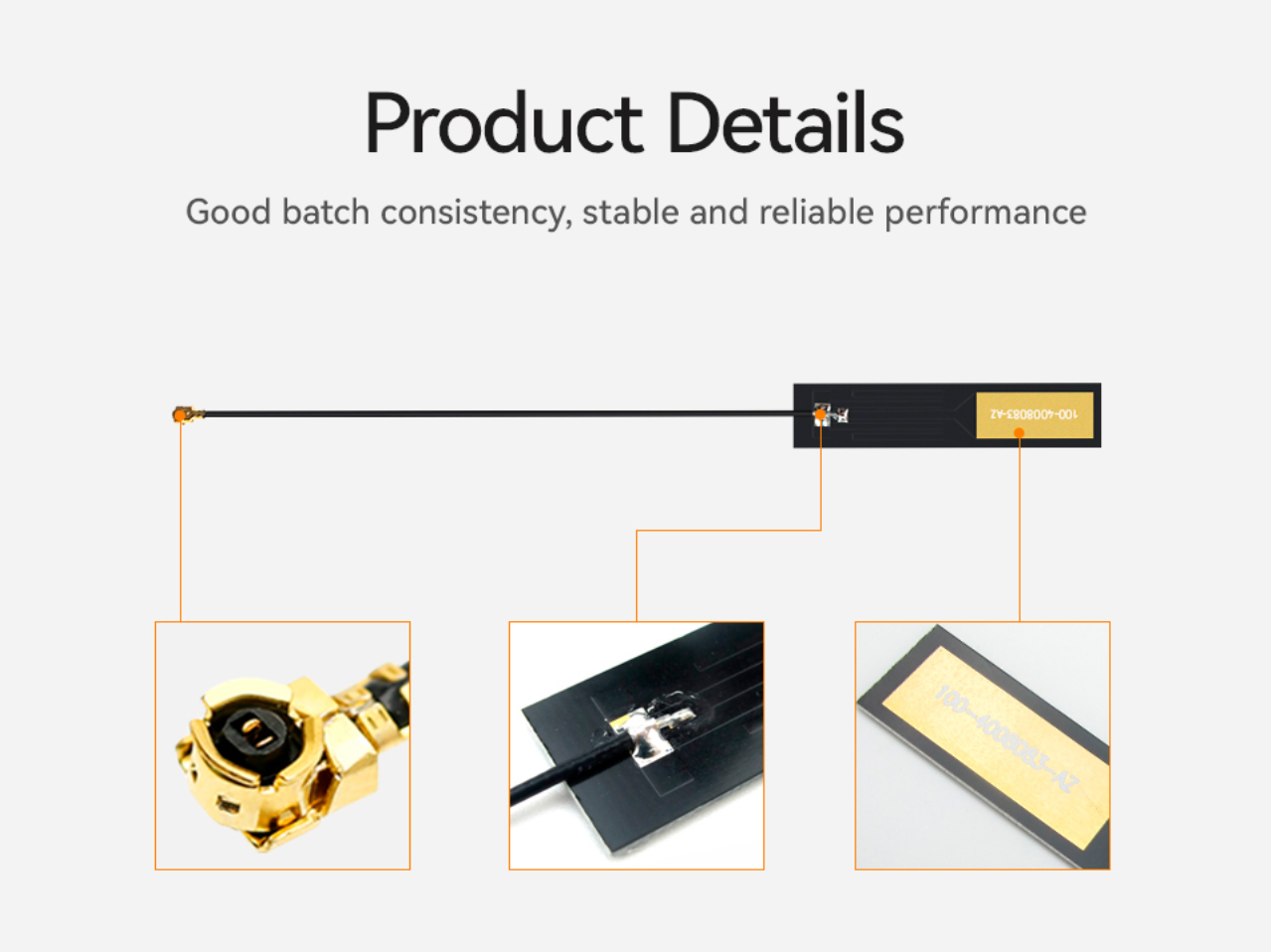
Product Details
66 × 13mm PCB Radiator — Enhanced Low-Band Aperture
The 66mm radiator length is optimized for multi-frequency resonance across the full 700–2700MHz LTE spectrum. The larger aperture compared to 44mm variants improves low-band (700–900MHz) efficiency, which is critical for building penetration in urban deployments and for NB-IoT/LTE-M devices operating on Band 20 (800MHz) or Band 28 (700MHz). The rigid PCB substrate maintains fixed geometry after installation, ensuring repeatable impedance matching across production batches.

Gold-Plated IPX-I Connector with 120mm Low-Loss Feeder
The gold-plated IPX-I (U.FL-compatible) connector ensures low-resistance mating with Quectel EC21/EC25, SIMCom SIM7600, and other LTE/NB-IoT modules. The 120mm coaxial feeder provides routing flexibility inside compact enclosures while maintaining signal integrity across the full 700–2700MHz band. Press-fit installation requires no soldering and is compatible with automated assembly lines.
Professional Test Report
Measured with a vector network analyzer (Agilent E5071C equivalent): VSWR ≤ 2.0 confirmed across the full 700–2700 MHz operating band. The ≤2.0 VSWR threshold is the accepted industry standard for wideband 4G/LTE internal antennas spanning a 3.9:1 frequency ratio.


Ideal Applications
4G Routers & DTU Terminals
Industrial 4G routers, data transmission units (DTU), and cellular IoT gateways using Quectel, SIMCom, or Telit LTE modules with IPX-I antenna ports.
NB-IoT & LTE-M Devices
Smart meters, environmental sensors, and asset trackers using NB-IoT (Band 20/28) or LTE-M protocols requiring reliable low-band cellular uplink with building penetration.
Smart Payment & Vending
Mobile POS terminals, smart vending machines, and cashless payment kiosks requiring a compact internal LTE antenna with broad band coverage for multi-region deployment.
Industrial Monitoring & SCADA
Remote industrial monitoring nodes, pipeline telemetry, and SCADA edge devices requiring cellular uplink across multiple LTE bands in areas with variable network coverage.
Resources
📄 Download Datasheet (PDF)Frequently Asked Questions
Q: Does the TX4G-PCB-6613 support NB-IoT and LTE-M bands?
A: Yes. The 700–2700MHz coverage includes the primary NB-IoT and LTE-M deployment bands globally: Band 20 (800MHz, Europe), Band 28 (700MHz, Asia-Pacific), Band 8 (900MHz), Band 3 (1800MHz), and Band 1 (2100MHz). This makes the TX4G-PCB-6613 suitable for LPWAN cellular devices using Quectel BC660, SIMCom SIM7020, or similar NB-IoT/LTE-M modules with IPX-I connectors.
Q: What is the advantage of the 66 × 13mm size over smaller 4G PCB antennas?
A: A larger PCB radiator provides a greater effective aperture, which improves radiation efficiency particularly in the low-band (700–900MHz) range where antenna electrical size is a limiting factor. The TX4G-PCB-6613 is recommended when low-band LTE performance (Band 20/28 for NB-IoT, or Band 5/8 for rural LTE coverage) is a priority. For enclosures where 66mm length is not feasible, the TX4G-PCB-4410 (44 × 10mm) is the compact alternative.
Q: Can this antenna be installed inside a metal enclosure?
A: No. Placing any PCB antenna inside a metallic housing causes severe signal attenuation due to RF shielding. The TX4G-PCB-6613 must be mounted inside a non-metallic (ABS, PC, or TPEE) enclosure with a minimum 5mm clearance from metal components. For metal enclosures, use an external LTE antenna with a bulkhead SMA or TNC connector routed through a feedthrough.
Q: How do I mount and connect the TX4G-PCB-6613?
A: Secure the 66 × 13mm PCB radiator to the inner wall of a non-metallic enclosure using a mounting hole or double-sided adhesive pad on the non-copper side. Route the 120mm coaxial feeder to your LTE or NB-IoT module's IPX-I (U.FL) antenna port and press-fit the connector until it clicks. Position the antenna away from battery packs, metal shielding cans, and switching power supplies. No soldering is required.
Q: What is the difference between the TX4G-PCB-6613 and TX4G-PCB-4410?
A: Both antennas cover 4G/LTE bands with 3.0 dBi gain and IPX-I connectors. The TX4G-PCB-6613 (66 × 13mm, 120mm cable) has a larger radiator that improves low-band (700–900MHz) efficiency for NB-IoT, LTE-M, and rural LTE deployments. The TX4G-PCB-4410 (44 × 10mm, 145mm cable) is more compact with a longer cable, suited for space-constrained enclosures where low-band performance is less critical. Choose based on your enclosure dimensions and target LTE band priorities.