


cdsenet
10pcs CdSENET TX4G-PCB-4410 4G LTE PCB Antenna 3.0dBi Dual-Band IPX-I IoT IPEX-I Generation Interface(Mobile Phones, Wireless Network Cards, Routers)
10pcs CdSENET TX4G-PCB-4410 4G LTE PCB Antenna 3.0dBi Dual-Band IPX-I IoT IPEX-I Generation Interface(Mobile Phones, Wireless Network Cards, Routers)
100 in stock
Couldn't load pickup availability
SKU:10-TX4G-PCB-4410


Product Overview
The TX4G-PCB-4410 is a 4G/LTE dual-band PCB internal antenna engineered for cellular IoT modules, industrial routers, and wireless gateways. It delivers a measured peak gain of 3.0 dBi across two frequency ranges: 690–960 MHz (LTE Band 5/8/12/13/17/20/28) and 1710–2700 MHz (LTE Band 1/2/3/4/7/25/38/40/41). The compact 44 × 10mm rigid PCB radiator with a 145mm IPX-I feeder cable provides a stable, low-profile mounting solution for mobile terminals, 4G routers, and industrial IoT gateways. Updated March 2026.

Technical Specifications
| Parameter | Value |
|---|---|
| Frequency Range | 690–960 MHz & 1710–2700 MHz (4G/LTE dual-band) |
| Peak Gain | 3.0 dBi |
| VSWR | ≤ 2.0 (Typ. 1.30 @ 2.70 GHz) — wideband LTE spec |
| Impedance | 50 Ω |
| Connector Type | IPX-I (IPEX Gen 1 / U.FL compatible) |
| Cable Length | 145 mm |
| Antenna Dimensions | 44 × 10 mm |
| Radiator Material | PCB (Printed Circuit Board, rigid) |
| Polarization | Linear (vertical) |
| Max Input Power | 50 W |
| Operating Temperature | -40 °C to +85 °C |
| Compliance | RoHS |
| Last Updated | March 2026 |
Product Details
Dual-Band LTE Coverage — 690–960 MHz & 1710–2700 MHz
A single TX4G-PCB-4410 covers both the low-band (700/850/900MHz) and mid/high-band (1800/2100/2600MHz) LTE spectrum, eliminating the need for two separate antennas in multi-band cellular modules such as Quectel EC21/EC25, SIMCom SIM7600, and Telit LE910. The omnidirectional radiation pattern and linear vertical polarization ensure consistent signal reception regardless of device orientation in fixed gateway installations.

44 × 10mm Rigid PCB with 145mm IPX-I Feeder
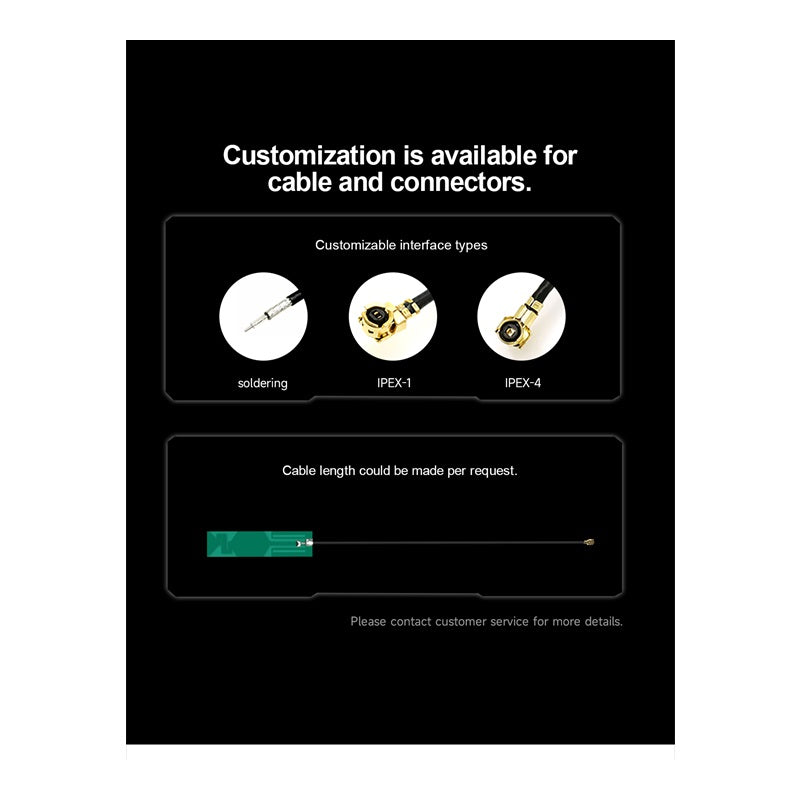
The rigid 44 × 10mm PCB substrate maintains fixed geometry after installation, ensuring repeatable impedance matching across production batches. The 145mm coaxial feeder provides generous routing clearance between the antenna mounting position and the cellular module's IPX-I socket, accommodating a wide range of enclosure layouts. The press-fit IPX-I connector requires no soldering and is compatible with automated assembly.
Professional Test Report
Measured with a vector network analyzer (Agilent E5071C equivalent): VSWR = 1.30 @ 2.70 GHz across the upper LTE band. The ≤2.0 VSWR specification is the industry-standard threshold for wideband 4G/LTE antennas covering a 4:1 frequency ratio (690–2700 MHz); measured values confirm compliance across both sub-bands.


Ideal Applications
4G Industrial Routers & Gateways
Industrial 4G routers, cellular IoT gateways, and SCADA communication nodes using Quectel, SIMCom, or Telit LTE modules with IPX-I antenna ports.
Mobile & Handheld Terminals
Handheld POS terminals, mobile data collectors, wireless network cards, and portable LTE hotspot devices requiring a compact internal antenna.
Smart Metering & Utility IoT
4G-connected smart electricity, water, and gas meters, and remote utility monitoring systems requiring reliable cellular uplink across multiple LTE bands.
Fleet & Asset Tracking
Vehicle telematics units, GPS/4G combined trackers, and fleet management devices requiring a compact internal LTE antenna with broad band coverage.
Resources
📄 Download Datasheet (PDF)Frequently Asked Questions
Q: Which LTE bands does the TX4G-PCB-4410 support?
A: The TX4G-PCB-4410 covers 690–960MHz (LTE Band 5, 8, 12, 13, 17, 20, 28) and 1710–2700MHz (LTE Band 1, 2, 3, 4, 7, 25, 38, 40, 41). This covers the majority of global 4G/LTE deployments in North America, Europe, Asia-Pacific, and Latin America. Verify your cellular module's operating bands against this list before selecting the antenna.
Q: Why is the VSWR specification ≤2.0 instead of ≤1.5?
A: Achieving ≤1.5 VSWR across a 4:1 frequency ratio (690–2700MHz) in a compact 44 × 10mm PCB form factor is physically impractical due to fundamental antenna bandwidth constraints. The ≤2.0 VSWR specification is the accepted industry standard for wideband 4G/LTE internal antennas. At VSWR = 2.0, reflected power is 11% — a loss of less than 0.5 dB, which has negligible impact on cellular link budgets. The measured typical value of 1.30 at 2.70GHz confirms strong performance in the upper band.
Q: Is the TX4G-PCB-4410 compatible with 5G NR modules?
A: The TX4G-PCB-4410 covers up to 2700MHz, which includes 5G NR Sub-6GHz bands n1, n3, n7, n38, n40, and n41 (within 1710–2700MHz). It is not designed for 5G NR bands above 2700MHz (n77/n78 at 3300–3800MHz or mmWave). For modules operating exclusively on 4G/LTE or 5G NR bands within 690–2700MHz, the TX4G-PCB-4410 is a compatible choice. Confirm your module's band plan before selecting.
Q: Can this antenna be installed inside a metal enclosure?
A: No. Placing any PCB antenna inside a metallic housing causes severe signal attenuation due to RF shielding. The TX4G-PCB-4410 must be mounted inside a non-metallic (ABS, PC, or TPEE) enclosure with a minimum 5mm clearance from metal components. For metal enclosures, use an external LTE antenna with a bulkhead SMA or TNC connector routed through a feedthrough.
Q: How do I mount the TX4G-PCB-4410 and connect it to my LTE module?
A: Secure the 44 × 10mm PCB radiator to the inner wall of a non-metallic enclosure using a mounting hole or double-sided adhesive pad on the non-copper side. Route the 145mm coaxial feeder to your LTE module's IPX-I (U.FL) antenna port and press-fit the connector until it clicks. Position the antenna away from battery packs, metal shielding cans, and other RF-absorbing components. No soldering is required.