


cdsenet
10pcs 433mhz PCBB Internal Uhf Antenna 2.0dbi Ipx-I Iot Ipx Wireless 4g Omnidirectional Antenna for Communication
10pcs 433mhz PCBB Internal Uhf Antenna 2.0dbi Ipx-I Iot Ipx Wireless 4g Omnidirectional Antenna for Communication
100 in stock
Couldn't load pickup availability
SKU:10-tx433-pcb-3207


Product Overview
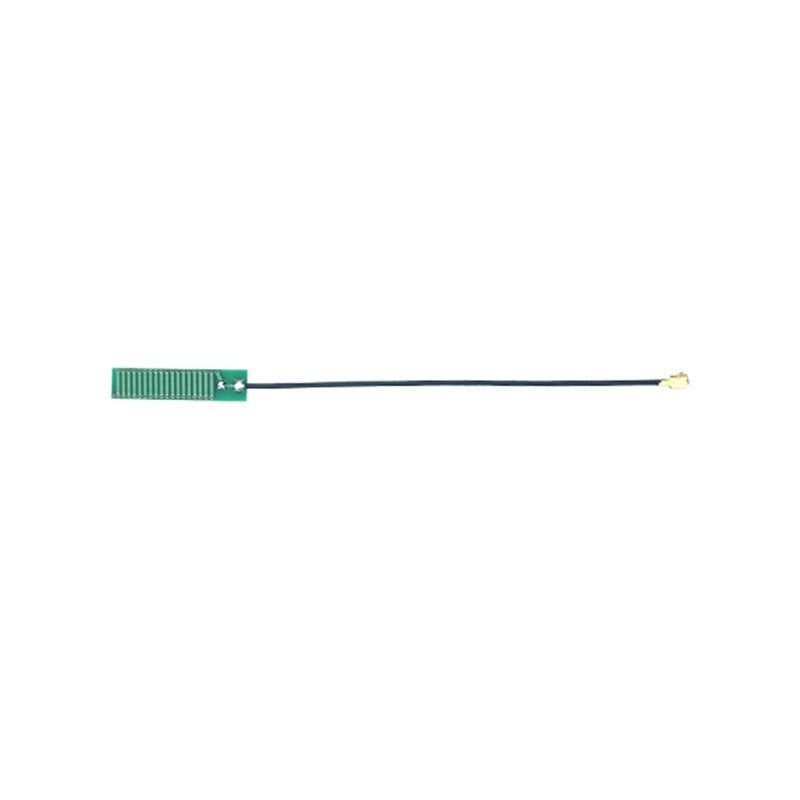
The TX433-PCB-3207 is a 433MHz PCB (Printed Circuit Board) internal antenna engineered for compact sub-1GHz IoT wireless modules. It delivers a measured peak gain of 2.0 dBi and a typical VSWR of 1.39 at 433MHz, covering the 423–443MHz band used by LoRa, FSK, and OOK-based devices. The rigid 32 × 7mm PCB radiator with a 90mm IPX-I feeder cable provides a stable, low-profile mounting solution for wireless modules, smart meters, and industrial IoT terminals where a fixed-form antenna is preferred over flexible FPC alternatives. Updated March 2026.

Technical Specifications
| Parameter | Value |
|---|---|
| Frequency Range | 423 – 443 MHz (Center: 433 MHz) |
| Peak Gain | 2.0 dBi |
| VSWR | ≤ 1.5 (Typ. 1.39 @ 433 MHz) |
| Impedance | 50 Ω |
| Connector Type | IPX-I (IPEX Gen 1 / U.FL compatible) |
| Cable Length | 90 mm |
| Antenna Dimensions | 32 × 7 mm |
| Radiator Material | PCB (Printed Circuit Board, rigid) |
| Max Input Power | 50 W |
| Operating Temperature | -40 °C to +85 °C |
| Compliance | RoHS |
| Last Updated | March 2026 |
Product Details
Rigid PCB Radiator — 32 × 7mm Stable Form Factor
Unlike FPC antennas, the TX433-PCB-3207 uses a rigid PCB substrate that maintains a fixed geometry after installation, ensuring consistent impedance matching and repeatable VSWR performance across production batches. The 32 × 7mm footprint fits standard module PCB keep-out zones and can be secured with a mounting hole or adhesive pad. The rigid body is resistant to deformation from vibration, making it suitable for industrial and automotive applications.

IPX-I Connector with 90mm Low-Loss Feeder
The standard IPX-I (U.FL-compatible) connector mates directly with Ebyte E32, E22-400, and third-party 433MHz LoRa/FSK modules. The 90mm coaxial feeder provides sufficient routing clearance between the antenna mounting position and the module socket, while keeping cable-induced insertion loss minimal at sub-1GHz frequencies. Press-fit installation requires no soldering and is compatible with automated assembly lines.
Professional Test Report
Measured with a vector network analyzer (Agilent E5071C equivalent): VSWR = 1.39 @ 433 MHz, confirming ≤1.5 across the full 423–443 MHz operating band. Return loss ≥ 16 dB at center frequency.


Ideal Applications
LoRa & FSK Wireless Modules
Long-range data acquisition nodes, pipeline monitoring, and factory automation using 433MHz LoRa or FSK modules with IPX-I sockets.
Smart Metering & Infrastructure
Wireless water, gas, and electricity meter reading systems and power monitoring devices requiring a rigid, dimensionally stable internal antenna.
Security & Alarm Systems
Wireless alarm panels, door/window sensors, and 433MHz RF remote control receivers in residential and commercial security installations.
Agricultural & Environmental Sensors
Soil moisture, temperature, and environmental monitoring nodes using 433MHz sub-1GHz for wide-area field coverage with low power consumption.
Resources
📄 Download Datasheet (PDF)Frequently Asked Questions
Q: Is the TX433-PCB-3207 compatible with third-party 433MHz LoRa modules?
A: Yes. The TX433-PCB-3207 uses a standard IPX-I (U.FL) connector and is electrically matched to 50Ω systems at 433MHz. It is compatible with Ebyte E32, E22-400, Semtech SX1276-based modules, and any third-party LoRa, FSK, or OOK module with an IPX-I socket in the 423–443MHz band. Confirm your module uses IPX-I (Gen 1) rather than IPX-4 (MHF4), as they are not interchangeable.
Q: What is the difference between a PCB antenna and an FPC antenna at 433MHz?
A: A PCB antenna uses a rigid substrate that maintains a fixed geometry after installation, providing consistent impedance matching and repeatable VSWR across production batches. An FPC antenna uses a flexible substrate that can conform to curved surfaces and is easier to route in irregular enclosures. Choose PCB (TX433-PCB-3207) when dimensional stability and vibration resistance are priorities; choose FPC (TX433-FPC-4516 / TX433-FPC-5711) when flexible mounting or curved surfaces are required.
Q: Can this antenna be installed inside a metal enclosure?
A: No. Placing any PCB or FPC antenna inside a metallic housing causes severe signal attenuation due to RF shielding. The TX433-PCB-3207 must be mounted inside a non-metallic (ABS, PC, or TPEE) enclosure with a minimum 5mm clearance from any metal component. For metal enclosures, use an external antenna with a bulkhead SMA connector instead.
Q: How do I mount the TX433-PCB-3207 inside my device?
A: The PCB radiator can be secured using a mounting hole (if present on the PCB) or a double-sided adhesive pad on the non-copper side. Route the 90mm coaxial feeder to your module's IPX-I socket and press-fit the connector until it clicks. Ensure the antenna is positioned parallel to the enclosure wall and away from battery packs, metal shielding cans, and other RF-absorbing components. No soldering is required.
Q: What is the operating temperature range and environmental durability?
A: The TX433-PCB-3207 is rated for -40°C to +85°C, covering industrial and outdoor deployment scenarios. The PCB substrate is RoHS-compliant. The rigid PCB construction is more resistant to deformation from thermal cycling than FPC alternatives, making it suitable for applications with wide temperature swings. For direct outdoor exposure, ensure the host enclosure provides adequate IP-rated sealing.