


cdsenet
Cdsenet TX2400-JZLW-15 2.4GHz 5dBi Cabinet Antenna IPEX-1 165mm+150mm Rubber Antenna
Cdsenet TX2400-JZLW-15 2.4GHz 5dBi Cabinet Antenna IPEX-1 165mm+150mm Rubber Antenna
100 in stock
Couldn't load pickup availability
SKU:TX2400-JZLW-15


Product Overview
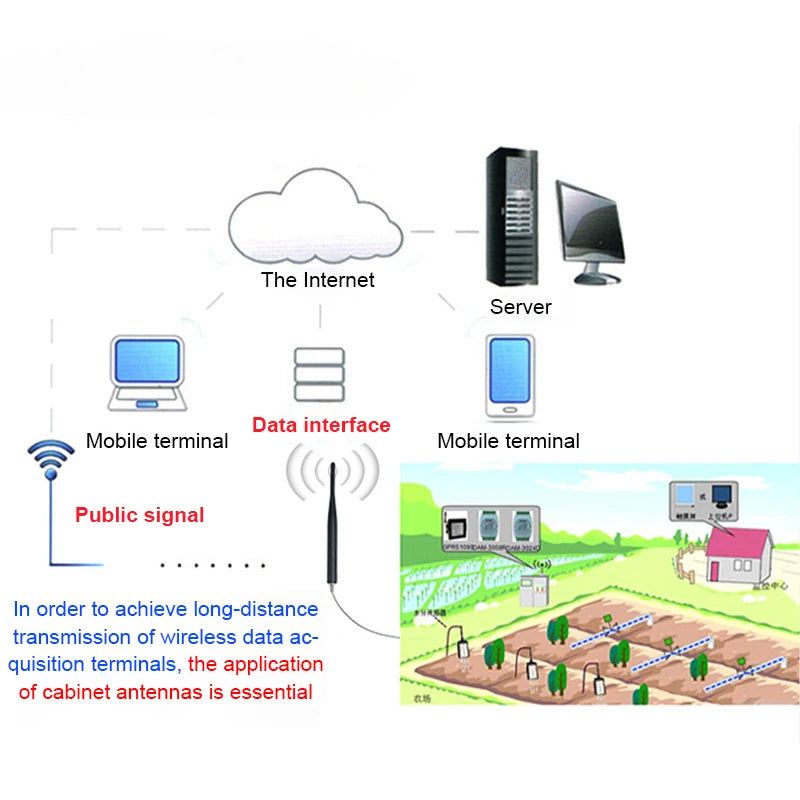
The TX2400-JZLW-15 is a 2.4GHz omnidirectional rubber rod antenna with an integrated 150mm extension feeder and IPEX-I connector, specifically engineered for industrial control cabinet installations where the wireless module is housed inside a metal enclosure and the antenna must be routed outside for unobstructed signal radiation. It delivers a measured peak gain of 5.0 dBi with a typical VSWR of 1.53 at 2.4GHz, covering the 2.4–2.5GHz ISM band. The 165mm flexible rubber rod mounts outside the cabinet while the 150mm feeder routes through a cable gland or aperture to the IPEX-I port on the wireless module inside. Updated March 2026.

Technical Specifications
| Parameter | Value |
|---|---|
| Frequency Range | 2.4 – 2.5 GHz (WiFi 802.11b/g/n, Bluetooth, ZigBee, ISM) |
| Peak Gain | 5.0 dBi |
| VSWR | Typ. 1.53 @ 2.4 GHz (spec: ≤ 2.0) |
| Impedance | 50 Ω |
| Connector Type | IPEX-I (IPEX Gen 1 / U.FL compatible, gold-plated) |
| Antenna Rod Length | 165 mm (flexible rubber) |
| Extension Feeder Length | 150 mm (customizable per order) |
| Radome Material | Rubber (flexible) |
| Radiation Pattern | Omnidirectional (vertical polarization) |
| Max Input Power | 50 W |
| Operating Temperature | -40 °C to +85 °C |
| Compliance | RoHS |
| Last Updated | March 2026 |
Product Details
165mm Rubber Rod + 150mm Feeder — Cabinet-Through Installation Design
The TX2400-JZLW-15 is designed specifically for installations where the wireless module is inside a metal control cabinet and the antenna must be positioned outside for unobstructed 2.4GHz signal radiation. The 150mm extension feeder routes through a cable gland, conduit aperture, or panel cutout in the cabinet wall, while the 165mm flexible rubber rod mounts vertically on the exterior. This separation eliminates the severe RF shielding effect of metal enclosures, which can attenuate 2.4GHz signals by 20–40 dB when the antenna is placed inside. The flexible rubber rod allows bending for installations where vertical clearance is limited outside the cabinet.

IPEX-I Connector — Direct Integration with WiFi, ZigBee, and Bluetooth Modules
The gold-plated IPEX-I (U.FL-compatible) connector at the end of the 150mm feeder mates directly with ESP32, nRF52840, CC2652, LoRa 2.4GHz, and other wireless modules with IPX-I antenna ports inside the control cabinet. The 150mm feeder length provides sufficient routing distance from the module's IPEX-I port to the cabinet wall aperture. Feeder length is customizable per order for cabinets requiring longer routing distances. Press-fit installation requires no soldering.
Professional Test Report
Measured with a vector network analyzer (Agilent E5071C equivalent): VSWR = 1.53 @ 2.4 GHz. Return loss ≈ 14 dB at the measured frequency point, indicating approximately 4% of input power is reflected at the antenna port — within acceptable limits for 2.4GHz IoT applications.


Ideal Applications
Industrial Control Cabinets
Smart control cabinets, distribution boxes, and electrical enclosures where the wireless module is inside a metal housing and the antenna must be routed outside through a cable gland or panel aperture.
IoT Gateways & Smart Security
IoT gateways, smart hotel management systems, property security nodes, and chain company wireless infrastructure where the gateway is in a metal enclosure and requires external antenna placement.
WiFi & ZigBee Module Integration
ESP32, nRF52840, CC2652, and LoRa 2.4GHz modules with IPEX-I ports installed inside metal enclosures, requiring a high-gain external antenna connected via the 150mm feeder.
Building Automation & Smart Metering
Building automation controllers, smart energy meters, and industrial monitoring systems in metal DIN-rail enclosures where 2.4GHz wireless connectivity requires external antenna routing.
Resources
📄 Download Datasheet (PDF)Frequently Asked Questions
Q: Why does this antenna use a feeder cable instead of a direct-mount connector?
A: The TX2400-JZLW-15 is designed for installations where the wireless module is inside a metal control cabinet. Metal enclosures attenuate 2.4GHz signals by 20–40 dB, making wireless communication unreliable when the antenna is inside. The 150mm feeder routes through a cable gland or panel aperture, allowing the 165mm rubber rod to be mounted outside the cabinet for unobstructed signal radiation while the IPEX-I connector mates with the module inside.
Q: Which wireless modules is the TX2400-JZLW-15 compatible with?
A: The IPEX-I (U.FL Gen 1) connector is compatible with any 2.4GHz wireless module featuring an IPEX-I antenna socket, including ESP32, ESP8266, nRF52840, CC2652, LoRa 2.4GHz modules, and Ebyte E18/E72/E104 series. Confirm your module uses IPEX-I (Gen 1) rather than IPEX-4 (MHF4) before ordering, as the two connector generations are not interchangeable despite similar appearance.
Q: The measured VSWR is 1.53 at 2.4GHz — does this affect performance?
A: A VSWR of 1.53 corresponds to a return loss of approximately 14 dB, meaning about 4% of transmitted power is reflected at the antenna port. For 2.4GHz IoT applications (WiFi, ZigBee, Bluetooth), this level of mismatch has a negligible impact on communication range — less than 0.2 dB of effective gain reduction. The VSWR improves toward the center of the band (2.45GHz), making the antenna well-suited for WiFi channels 1–13 and Bluetooth operation.
Q: Can the 150mm feeder length be customized?
A: Yes. The standard feeder length is 150mm, but custom lengths are available per order for cabinets requiring longer routing distances. Note that at 2.4GHz, each additional 100mm of feeder cable adds approximately 0.3–0.5 dB of insertion loss. For feeder lengths exceeding 400mm, consider using a lower-loss cable type to minimize signal attenuation between the module and the antenna.
Q: How should the antenna rod be mounted on the outside of the cabinet?
A: Route the 150mm feeder through a cable gland (PG7 or M12 size recommended) or a panel aperture in the cabinet wall. Mount the rubber rod vertically on the exterior surface using the antenna's base or a bracket. Keep the rod at least 50mm away from the metal cabinet surface to minimize ground plane detuning effects. The flexible rubber rod can be bent if vertical clearance is limited, though bending will alter the radiation pattern from omnidirectional.