


cdsenet
Cdsenet TX2400-JW-5 2.4GHz Rubber Antenna 2.0dBi SMA-J TPEE IoT WiFi Compact Size
Cdsenet TX2400-JW-5 2.4GHz Rubber Antenna 2.0dBi SMA-J TPEE IoT WiFi Compact Size
1000 in stock
Couldn't load pickup availability
SKU:TX2400-JW-5


Product Overview
The TX2400-JW-5 is a 2.4GHz omnidirectional rubber stick antenna designed for compact wireless IoT terminals. It delivers a measured peak gain of 2.0 dBi and a typical VSWR of 1.40 at 2.45GHz, covering the 2.4–2.52GHz band used by Wi-Fi 4/5, Bluetooth 5.x, ZigBee, and Thread protocols. The 50 × 10mm TPEE-encased body provides weather resistance and mechanical flexibility, making it suitable for both indoor smart home devices and protected outdoor industrial enclosures. Updated March 2026.

Technical Specifications
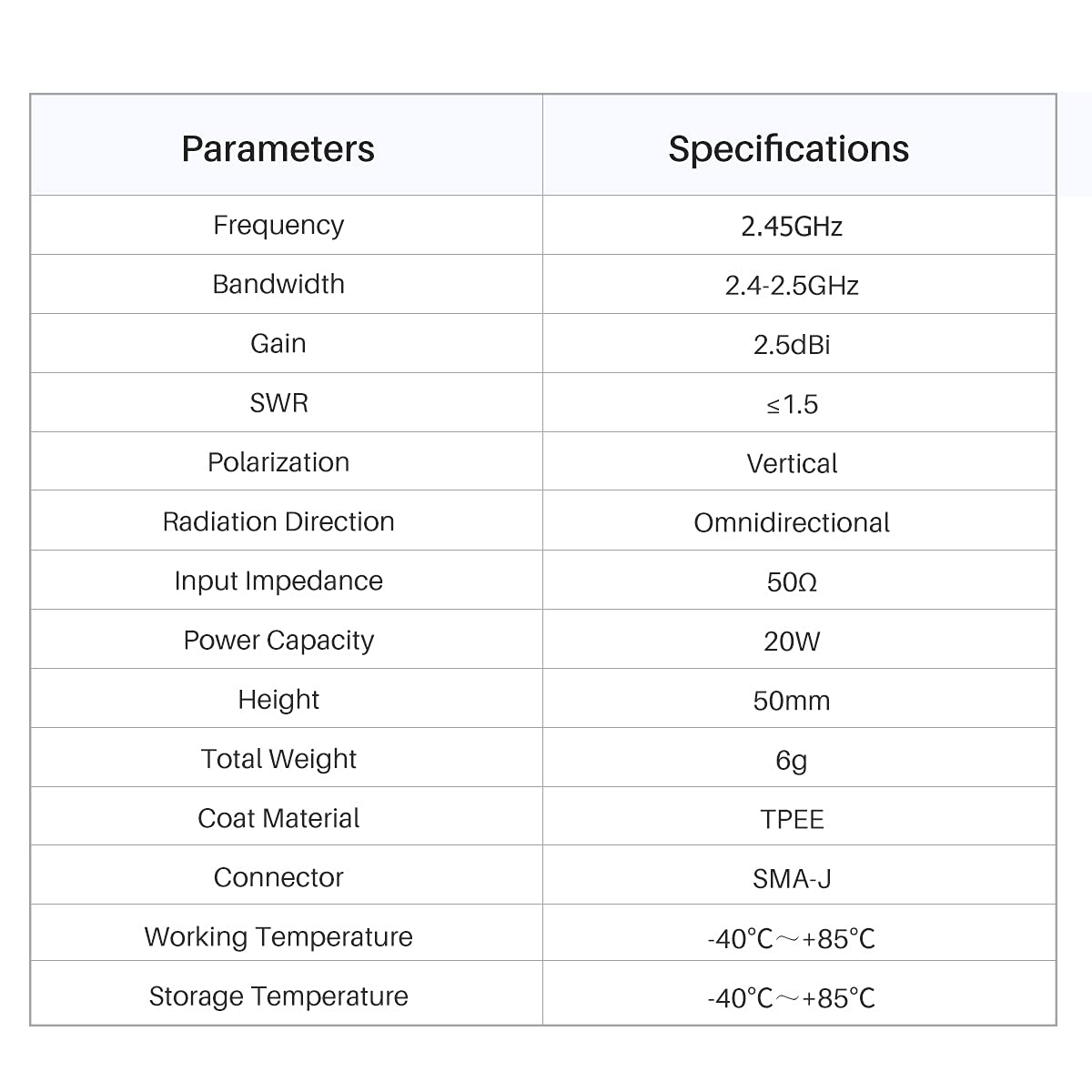
| Parameter | Value |
|---|---|
| Frequency Range | 2400 – 2520 MHz (Center: 2450 MHz) |
| Peak Gain | 2.0 dBi |
| VSWR | ≤ 1.5 (Typ. 1.40 @ 2.45 GHz) |
| Impedance | 50 Ω |
| Connector Type | SMA-J (SMA Male, inner pin) |
| Antenna Dimensions | 50 × 10 mm (H × D) |
| Radome Material | TPEE (weather-resistant, flexible) |
| Radiation Pattern | Omnidirectional (vertical polarization) |
| Max Input Power | 50 W |
| Operating Temperature | -40 °C to +85 °C |
| Compliance | RoHS |
| Last Updated | March 2026 |
Product Details
50 × 10mm Ultra-Compact TPEE Body
At just 50mm tall and 10mm in diameter, the TX2400-JW-5 occupies minimal panel space while maintaining a full omnidirectional radiation pattern. The TPEE (Thermoplastic Polyester Elastomer) radome is UV-resistant, flexible under mechanical stress, and rated for -40°C to +85°C, making it suitable for both consumer electronics and industrial enclosures without additional protective housing.

Precision SMA-J Connector — Broad Module Compatibility
The precision-machined SMA-J (male, inner pin) connector provides a secure 50Ω impedance-matched interface to SMA-K female ports on Wi-Fi modules, Bluetooth gateways, ZigBee coordinators, and industrial wireless routers. The connector is rated for 500+ mating cycles, ensuring long-term reliability in field-serviceable installations.
Professional Test Report
Measured with Agilent E5071C vector network analyzer: VSWR = 1.40 @ 2.45 GHz, confirming ≤1.5 across the full 2.4–2.52 GHz operating band. Return loss ≥ 15 dB at center frequency.


Ideal Applications
Smart Home & Wi-Fi Gateways
Wi-Fi 4/5 routers, smart home hubs, wireless smart locks, and Bluetooth 5.x mesh network coordinators requiring a compact external antenna.
Industrial IoT & ZigBee
ZigBee 3.0 coordinators, Thread border routers, and industrial wireless sensors operating in the 2.4GHz ISM band for factory automation and SCADA systems.
Agricultural Monitoring
Wireless soil, humidity, and temperature sensor nodes using 2.4GHz protocols for greenhouse automation and precision agriculture deployments.
Automotive & Fleet Telematics
In-vehicle Wi-Fi access points, Bluetooth OBD-II adapters, and fleet telematics units requiring a compact, vibration-resistant 2.4GHz antenna.
Resources
📄 Download Datasheet (PDF)Frequently Asked Questions
Q: Is the TX2400-JW-5 compatible with Wi-Fi, Bluetooth, and ZigBee modules?
A: Yes. The TX2400-JW-5 covers 2400–2520MHz, which encompasses Wi-Fi 4/5 (802.11b/g/n/ac), Bluetooth 4.x/5.x, ZigBee 3.0, Thread, and Matter over Thread protocols. It requires an SMA-K (female) port on the host module. Confirm your module uses SMA (not RP-SMA) before ordering, as the two connector types are not interchangeable despite appearing similar.
Q: Can the TX2400-JW-5 be used outdoors?
A: The TPEE radome is UV-resistant and rated for -40°C to +85°C, making it suitable for protected outdoor installations such as under eaves, inside ventilated enclosures, or in sheltered industrial environments. The antenna itself is not independently IP-rated. For direct rain exposure, mount it inside an IP65 or higher enclosure with the SMA connector sealed using self-amalgamating tape.
Q: What is the difference between SMA and RP-SMA connectors?
A: Standard SMA-J (used on the TX2400-JW-5) has an inner pin on the antenna side and mates with an SMA-K female port (inner socket) on the device. RP-SMA (Reverse Polarity SMA) reverses this arrangement: the antenna has an inner socket and the device has an inner pin. Many consumer Wi-Fi routers use RP-SMA. Always verify your device's connector type before purchasing to avoid incompatibility.
Q: How does the 2.0 dBi gain compare to higher-gain 2.4GHz antennas?
A: A 2.0 dBi omnidirectional antenna provides a near-spherical radiation pattern suitable for multi-directional coverage in indoor and short-range outdoor environments. Higher-gain antennas (5–9 dBi) compress the vertical beam angle to extend horizontal range but reduce coverage above and below the antenna. For smart home hubs, ZigBee coordinators, and devices with nearby nodes in all directions, 2.0 dBi is the appropriate choice.
Q: What is the operating temperature range and mechanical durability?
A: The TX2400-JW-5 operates from -40°C to +85°C. The TPEE body is flexible and resistant to cracking under mechanical stress or vibration, unlike rigid ABS antennas. The SMA-J connector is rated for 500+ mating cycles. These characteristics make it suitable for automotive telematics, industrial equipment, and other applications subject to vibration or repeated connector engagement.