


cdsenet
Cdsenet TX2400-JKS-IPX20 2.4GHz WiFi Antenna 5dBi IPEX-I TPEE 200mm Rubber Antenna
Cdsenet TX2400-JKS-IPX20 2.4GHz WiFi Antenna 5dBi IPEX-I TPEE 200mm Rubber Antenna
1000 in stock
Couldn't load pickup availability
SKU:TX2400-JKS-IPX20


Product Overview
The TX2400-JKS-IPX20 is a 2.4GHz omnidirectional TPEE rubber stick antenna with an IPEX-I connector, engineered for embedded wireless modules, digital radio stations, and industrial remote control systems requiring high gain in a compact, cable-connected form factor. It delivers a measured peak gain of 5.0 dBi and a typical VSWR of 1.26 at 2.45GHz, covering the full 2.4–2.5GHz ISM band. The 197mm TPEE antenna body supports bending for flexible orientation, while the 200mm RG1.37 coaxial feeder with gold-plated IPEX-I connector enables direct integration with 2.4GHz wireless modules in compact enclosures. Updated March 2026.

Technical Specifications
| Parameter | Value |
|---|---|
| Frequency Range | 2.4 – 2.5 GHz (WiFi 802.11b/g/n, Bluetooth, ZigBee, ISM) |
| Peak Gain | 5.0 dBi |
| VSWR | ≤ 2.0 (Typ. 1.26 @ 2.45 GHz) |
| Impedance | 50 Ω |
| Connector Type | IPEX-I (IPEX Gen 1 / U.FL compatible, gold-plated) |
| Cable | 200 mm RG1.37 coaxial (customizable per order) |
| Antenna Body Height | 197 mm |
| Radome Material | TPEE (flexible, bendable, weather-resistant) |
| Radiator Material | Copper |
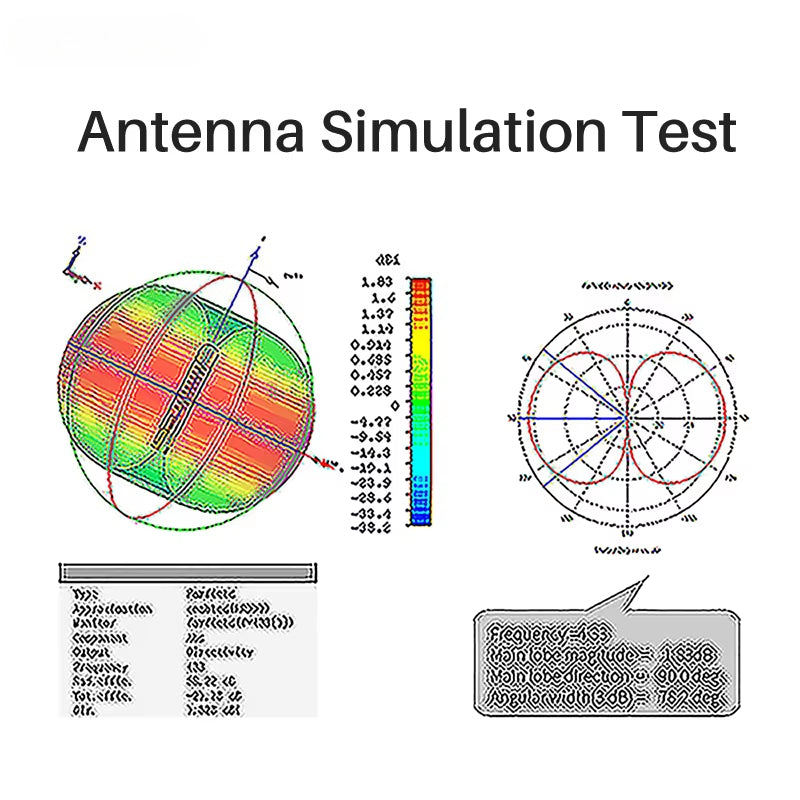
| Radiation Pattern | Omnidirectional (vertical polarization) |
| Max Input Power | 50 W |
| Operating Temperature | -40 °C to +85 °C |
| Compliance | RoHS |
| Last Updated | March 2026 |
Product Details
197mm TPEE Bendable Body — 5.0 dBi High-Gain for Embedded Module Installations
The 197mm TPEE antenna body achieves 5.0 dBi gain through a 5/8-wave equivalent radiator design at 2.4GHz, compressing the radiation pattern toward the horizon for increased horizontal gain compared to standard quarter-wave (2.15 dBi) antennas. The TPEE radome allows bending to various angles for flexible orientation in space-constrained enclosures, while maintaining the copper radiator's electrical length. This combination of high gain and flexible form factor makes the TX2400-JKS-IPX20 suitable for embedded module installations where a rigid external antenna cannot be used.

Gold-Plated IPEX-I Connector with 200mm RG1.37 Feeder
The gold-plated IPEX-I (U.FL-compatible) connector mates directly with ESP32, ESP8266, nRF52840, CC2652, and other 2.4GHz wireless SoCs and modules with IPX-I antenna ports. The 200mm RG1.37 coaxial feeder provides routing flexibility inside compact IoT enclosures while maintaining signal integrity at 2.4GHz. RG1.37's 1.37mm outer diameter enables routing through tight spaces inside enclosures. Cable length is customizable per order for high-volume production runs. Press-fit installation requires no soldering.
Professional Test Report
Measured with a vector network analyzer (Agilent E5071C equivalent): VSWR = 1.26 @ 2.45 GHz, confirming ≤2.0 across the full 2.4–2.5 GHz operating band. Return loss ≈ 19 dB at the measured frequency point.


Ideal Applications
Embedded 2.4GHz Wireless Modules
Internal high-gain antenna for 2.4GHz wireless modules with IPEX-I sockets, including ESP32, nRF52840, and CC2652-based designs where a 5.0 dBi gain extends range beyond standard chip antennas.
Digital Radio & Remote Control
2.4GHz digital radio station systems, industrial remote control equipment, and telemetry terminals requiring high-gain IPEX-connected antennas with flexible cable routing inside enclosures.
Smart Home & IoT Gateways
Smart home gateways, WiFi IoT hubs, and ZigBee coordinators where the 5.0 dBi gain and 200mm cable provide positioning flexibility to place the antenna at the optimal location inside the enclosure.
Industrial IoT & Agricultural Monitoring
Industrial sensor nodes, agricultural monitoring systems, and wide-area IoT deployments using 2.4GHz WiFi or ZigBee, where the 5.0 dBi gain extends communication range in non-metallic enclosures.
Resources
📄 Download Datasheet (PDF)Frequently Asked Questions
Q: What is the difference between the TX2400-JKS-IPX20 and TX2400-JK-11?
A: Both cover 2.4–2.5GHz with TPEE radomes, but differ in connector, gain, and form factor. The TX2400-JKS-IPX20 uses an IPEX-I connector with a 200mm RG1.37 feeder, delivers 5.0 dBi gain, and is designed for embedded module integration. The TX2400-JK-11 uses a direct SMA-J connector (no cable), delivers 2.5 dBi gain, and mounts directly on SMA-K ports. Choose IPX20 for IPEX-I module ports requiring high gain; choose JK-11 for direct SMA-K port mounting with standard gain.
Q: Which 2.4GHz modules is the TX2400-JKS-IPX20 compatible with?
A: The TX2400-JKS-IPX20 is compatible with any 2.4GHz wireless module or SoC featuring an IPEX-I (U.FL / IPX Gen 1) antenna socket, including ESP32, ESP8266, nRF52840, CC2652, Si4463, and Ebyte E18/E72/E104 series modules. Confirm your module uses IPEX-I (Gen 1) rather than IPEX-4 (MHF4) before ordering, as the two connector generations are not interchangeable despite similar appearance.
Q: Can this antenna be installed inside a metal enclosure?
A: No. The TPEE antenna body must be positioned inside a non-metallic (ABS, PC, or TPEE) enclosure with at least 5mm clearance from metal components. At 2.4GHz, metal surfaces within close proximity cause severe signal attenuation and antenna detuning. The 200mm RG1.37 cable allows the IPEX-I connector to mate with a module inside a metal enclosure while routing the antenna body through a non-metallic section or aperture.
Q: Can the 200mm cable length be customized?
A: Yes. The standard cable length is 200mm, but custom lengths are available per order for high-volume production runs. Note that at 2.4GHz, each additional 100mm of RG1.37 cable adds approximately 0.3–0.5 dB of insertion loss, which should be accounted for in the system link budget. For cable lengths exceeding 500mm, consider using a lower-loss cable type such as RG178 or RG316.
Q: What is the operating temperature range and is the TPEE radome suitable for outdoor use?
A: The TX2400-JKS-IPX20 is rated for -40°C to +85°C. The TPEE radome is weather-resistant and UV-stable, suitable for protected outdoor installations inside IP65+ enclosures. The antenna itself is not independently IP-rated and must be protected by the device enclosure from direct rain and condensation. The TPEE material provides better crack resistance than standard rubber under repeated temperature cycling and UV exposure.