


cdsenet
Cdsenet TX2400-JK-11 2.4GHz WiFi Antenna 2.5dBi SMA-J TPEE 110mm IoT Rubber Antenna Omnidirectional Antenna
Cdsenet TX2400-JK-11 2.4GHz WiFi Antenna 2.5dBi SMA-J TPEE 110mm IoT Rubber Antenna Omnidirectional Antenna
1000 in stock
Couldn't load pickup availability
SKU:TX2400-JK-11


Product Overview
The TX2400-JK-11 is a 2.4GHz omnidirectional rubber stick antenna with a TPEE radome, engineered for direct-mount use on 2.4GHz wireless modules, IoT terminals, smart home devices, and industrial sensor nodes. It delivers a measured peak gain of 2.5 dBi and a typical VSWR of 1.15 at 2.4GHz — corresponding to a return loss of approximately 23 dB — across the 2.4–2.52GHz ISM band. The TPEE radome provides flexibility and impact resistance for daily bends and industrial vibrations, while the nickel-plated copper SMA-J connector with gold-plated pins ensures low-loss signal transfer. Updated March 2026.

Technical Specifications
| Parameter | Value |
|---|---|
| Frequency Range | 2.4 – 2.52 GHz (WiFi 802.11b/g/n, Bluetooth, ZigBee, ISM) |
| Peak Gain | 2.5 dBi |
| VSWR | ≤ 1.5 (Typ. 1.15 @ 2.4 GHz — return loss ≈ 23 dB) |
| Impedance | 50 Ω |
| Connector Type | SMA-J (SMA Male, nickel-plated copper, gold-plated pin) |
| Radome Material | TPEE (flexible, impact-resistant, UV-stable) |
| Radiation Pattern | Omnidirectional (vertical polarization) |
| Max Input Power | 50 W |
| Operating Temperature | -40 °C to +85 °C |
| Compliance | RoHS |
| Last Updated | March 2026 |
Product Details
TPEE Flexible Radome — Impact-Resistant for Industrial Vibration Environments
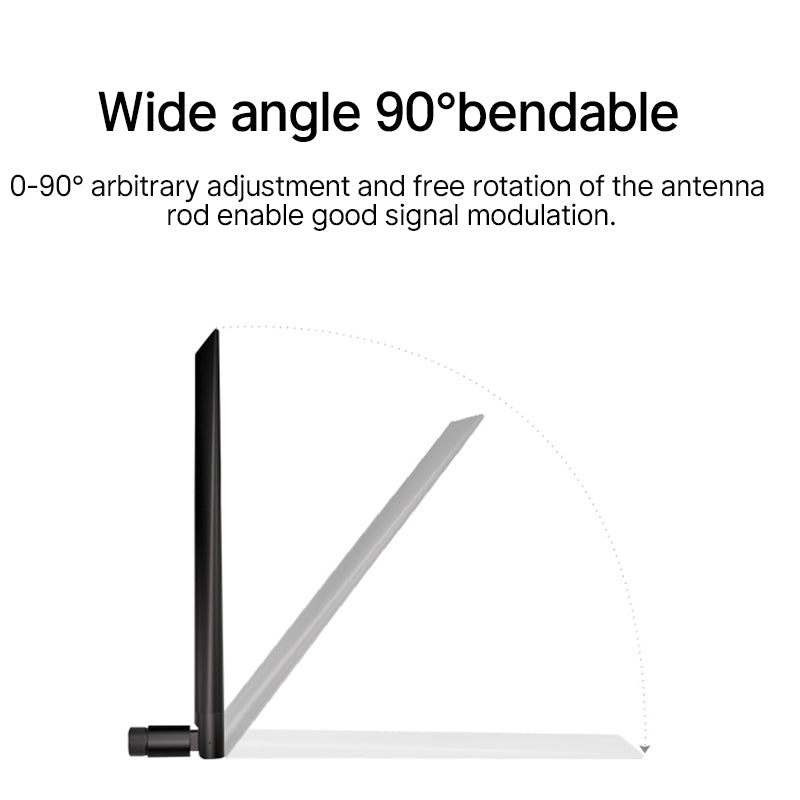
The TPEE (Thermoplastic Polyester Elastomer) radome provides superior toughness and elasticity compared to standard rubber compounds, allowing the antenna to withstand repeated bending and industrial vibrations without cracking or performance degradation. TPEE maintains its mechanical properties across the full -40°C to +85°C operating range and is UV-stable for protected outdoor installations. The flexibility allows the antenna to be bent to various angles for space-constrained mounting on IoT modules and industrial terminals.

Nickel-Plated Copper SMA-J with Gold-Plated Pin — Low-Loss 50Ω Interface
The precision-machined nickel-plated copper SMA-J (male, inner pin) connector with gold-plated contact pin provides a corrosion-resistant, low-loss 50Ω interface to SMA-K female ports on 2.4GHz wireless modules, IoT gateways, and industrial terminals. Gold plating on the contact pin minimizes contact resistance and prevents oxidation over repeated mating cycles. The connector is rated for 50W maximum input power, accommodating the full output range of 2.4GHz wireless equipment.
Professional Test Report
Measured with Agilent E5071C vector network analyzer: VSWR = 1.15 @ 2.4 GHz, confirming ≤1.5 across the full 2.4–2.52 GHz operating band. Return loss ≈ 23 dB at center frequency — indicating less than 0.5% of input power is reflected at the antenna port.


Ideal Applications
2.4GHz IoT Modules & Wireless Terminals
Direct-mount antenna for 2.4GHz wireless modules, IoT gateways, and handheld terminals with SMA-K female ports, covering WiFi 802.11b/g/n, Bluetooth 5.x, ZigBee 3.0, and Thread protocols.
Smart Home & Building Automation
Smart home controllers, ZigBee coordinators, Bluetooth mesh gateways, and Matter-compatible devices requiring a compact, flexible 2.4GHz external antenna.
Industrial IoT & Telemetry
Industrial sensor nodes, wireless data acquisition terminals, and ZigBee industrial networks where the TPEE radome provides durability against vibration and temperature cycling in harsh environments.
Agricultural & Environmental Monitoring
WiFi or ZigBee-connected environmental sensors for smart agriculture, greenhouse monitoring, and outdoor IoT nodes where the TPEE housing withstands UV exposure and temperature extremes.
Resources
📄 Download Datasheet (PDF)Frequently Asked Questions
Q: What is the difference between the TX2400-JK-11 and TX2400-JKD-20?
A: Both antennas use TPEE radomes and SMA-J connectors for 2.4GHz applications, but differ in gain and size. The TX2400-JK-11 delivers 2.5 dBi with a compact form factor and VSWR of 1.15 at 2.4GHz — optimized for direct-mount on IoT modules and compact devices. The TX2400-JKD-20 delivers 5.0 dBi with a 200mm radiator for extended range on routers and APs. Choose JK-11 for compact IoT module mounting; choose JKD-20 for maximum range on routers and access points.
Q: Which 2.4GHz protocols does the TX2400-JK-11 support?
A: The 2.4–2.52GHz frequency range covers WiFi 802.11b/g/n (2.412–2.484GHz), Bluetooth Classic and BLE 5.x (2.402–2.480GHz), ZigBee 3.0 (2.405–2.480GHz), Thread, Matter, and proprietary 2.4GHz FSK/GFSK protocols. It is compatible with any 2.4GHz wireless module or SoC with an SMA-K (female) antenna port, including ESP32, nRF52840, CC2652, and Ebyte E18/E72 series modules.
Q: Is the TX2400-JK-11 compatible with RP-SMA ports on consumer WiFi routers?
A: No. The TX2400-JK-11 uses an SMA-J (standard SMA male) connector, which is not compatible with RP-SMA (Reverse Polarity SMA) ports commonly found on consumer WiFi routers. RP-SMA reverses the pin/socket arrangement — the router port has an inner pin, while SMA-J also has an inner pin, making them mechanically similar but electrically incompatible. For RP-SMA router ports, use an RP-SMA male antenna or an SMA-to-RP-SMA adapter.
Q: Does bending the TPEE antenna affect RF performance?
A: Yes. The VSWR specification of ≤1.5 is measured with the antenna in a straight vertical position. Bending alters the radiation pattern — a bent antenna no longer radiates in a purely omnidirectional pattern. The TPEE material allows bending without mechanical damage, but for applications requiring consistent omnidirectional coverage, mount the antenna vertically. Use the bend capability only for space-constrained installations where pattern symmetry is less critical.
Q: What is the operating temperature range and is it suitable for outdoor use?
A: The TX2400-JK-11 is rated for -40°C to +85°C. The TPEE radome is UV-stable and weather-resistant, suitable for protected outdoor installations such as industrial cabinets and outdoor IoT enclosures. For direct rain exposure, protect the SMA connector junction with self-amalgamating tape. TPEE provides better crack resistance than standard rubber under repeated temperature cycling and UV exposure.