

cdsenet
Cdsenet TX230-JKS-IPX20 230MHz TPEE Antenna 3.0dBi IPEX-I 200mm IoT
Cdsenet TX230-JKS-IPX20 230MHz TPEE Antenna 3.0dBi IPEX-I 200mm IoT
10000 in stock
Couldn't load pickup availability
SKU:tx230-jks-ipx20
Product Overview
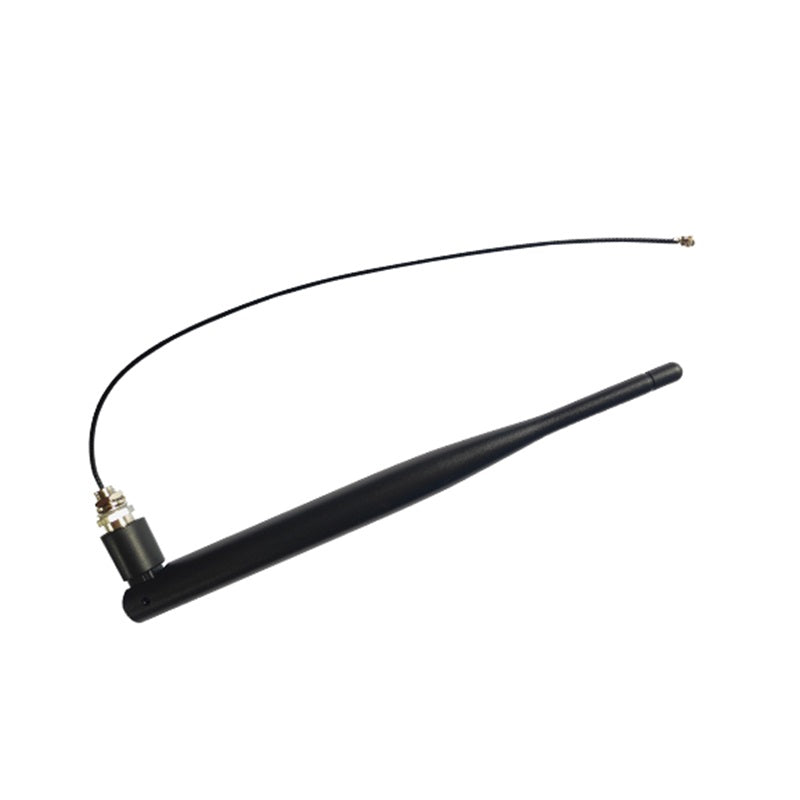
The TX230-JKS-IPX20 is a 230MHz VHF flexible TPEE rod antenna with an IPEX-I connector, engineered for embedded wireless modules, digital radio stations, and industrial remote control systems. It delivers a measured peak gain of 3.0 dBi and a typical VSWR of 1.08 at 230MHz — corresponding to a return loss of approximately 27 dB — across the 224–234MHz operating band. The 200mm RG1.37 coaxial feeder with gold-plated IPEX-I connector enables direct integration with wireless modules in compact enclosures, while the TPEE radome allows up to 90° bending for space-constrained installations. Updated March 2026.

Technical Specifications
| Parameter | Value |
|---|---|
| Frequency Range | 224 – 234 MHz (Center: 230 MHz) |
| Peak Gain | 3.0 dBi |
| VSWR | ≤ 2.0 (Typ. 1.08 @ 230 MHz — return loss ≈ 27 dB) |
| Impedance | 50 Ω |
| Connector Type | IPEX-I (IPEX Gen 1 / U.FL compatible, gold-plated) |
| Cable | 200 mm RG1.37 coaxial |
| Radome Material | TPEE (flexible, weather-resistant, up to 90° bend) |
| Radiator Material | Copper |
| Radiation Pattern | Omnidirectional (vertical polarization) |
| Max Input Power | 10 W |
| Operating Temperature | -40 °C to +85 °C |
| Compliance | RoHS |
| Last Updated | March 2026 |
Product Details
TPEE Flexible Radome — Up to 90° Bend for Compact Module Installations
The TPEE (Thermoplastic Polyester Elastomer) radome supports bending up to 90° without damaging the internal copper radiator, enabling installation in enclosures where a rigid vertical antenna cannot fit. Unlike standard rubber compounds, TPEE maintains its mechanical properties across the full -40°C to +85°C operating range and resists cracking under repeated flexing. The 3M adhesive backing on the antenna body allows tool-free mounting on the inner wall of non-metallic enclosures.

Gold-Plated IPEX-I Connector with 200mm RG1.37 Feeder
The gold-plated IPEX-I (U.FL-compatible) connector mates directly with 230MHz wireless modules featuring an IPX-I socket, including Ebyte E62-230T30S and similar sub-GHz VHF modules. The 200mm RG1.37 coaxial feeder provides routing flexibility inside compact enclosures while maintaining signal integrity at 230MHz. RG1.37 is a thin, low-loss coaxial cable optimized for short-run internal routing in space-constrained IoT devices. Press-fit installation requires no soldering.
Professional Test Report
Measured with a vector network analyzer (Agilent E5071C equivalent): VSWR = 1.08 @ 230 MHz, confirming ≤2.0 across the full 224–234 MHz operating band. Return loss ≈ 27 dB at center frequency — indicating less than 0.2% of input power is reflected at the antenna port. This is an exceptionally low VSWR for a flexible TPEE antenna at VHF frequencies.


Ideal Applications
Embedded 230MHz Wireless Modules
Internal antenna for 230MHz wireless data modules with IPEX-I sockets, including digital radio station systems and sub-GHz VHF transceivers in compact enclosures.
Industrial Remote Control & Telemetry
Industrial remote control systems, telemetry terminals, and SCADA edge nodes operating at 230MHz where an internal IPEX-connected antenna is required for enclosure integration.
Smart Grid & Utility Monitoring
Smart grid monitoring nodes, power line communication devices, and utility infrastructure sensors using 230MHz VHF for reliable long-range uplink in urban environments.
Agricultural & Environmental IoT
Long-range IoT sensor nodes for soil, weather, and irrigation monitoring using 230MHz VHF, where the IPEX-I connector enables direct integration with compact wireless module PCBs.
Resources
📄 Download Datasheet (PDF)Frequently Asked Questions
Q: What is the difference between the TX230-JKS-IPX20 and the TX230-JK-11?
A: Both antennas operate at 230MHz with similar VSWR performance (1.08 vs 1.09). The key differences are: TX230-JKS-IPX20 uses an IPEX-I connector with a 200mm RG1.37 feeder for embedded module integration, delivers 3.0 dBi gain, and covers 224–234MHz. TX230-JK-11 uses a direct SMA-J connector (no cable), delivers 2.5 dBi gain, and covers 225–237MHz. Choose IPX20 for modules with IPEX-I sockets; choose JK-11 for devices with SMA-K ports.
Q: Is the TX230-JKS-IPX20 compatible with all 230MHz wireless modules?
A: The TX230-JKS-IPX20 is tuned for 224–234MHz and requires an IPEX-I (U.FL) socket on the host module. It is compatible with Ebyte E62-230T30S and similar 230MHz sub-GHz VHF modules with IPX-I antenna ports. Confirm your module operates within 224–234MHz and uses IPEX-I (Gen 1) rather than IPEX-4 (MHF4) before ordering, as the two connector generations are not interchangeable.
Q: What is RG1.37 cable and why is it used instead of standard RG58?
A: RG1.37 is a thin, flexible coaxial cable with an outer diameter of approximately 1.37mm, designed for short-run internal routing in compact IoT devices and wireless modules. Compared to RG58 (5mm OD), RG1.37 is significantly thinner and more flexible, enabling routing through tight spaces inside enclosures. At 230MHz and 200mm cable length, the insertion loss of RG1.37 is negligible (<0.1 dB), making it suitable for this application without measurable signal degradation.
Q: Can this antenna be installed inside a metal enclosure?
A: No. Placing any TPEE or FPC antenna inside a metallic housing causes severe signal attenuation due to RF shielding. The TX230-JKS-IPX20 must be mounted inside a non-metallic (ABS, PC, or TPEE) enclosure with a minimum 5mm clearance from metal components. For metal enclosures, use an external 230MHz antenna with a bulkhead SMA connector routed through a feedthrough.
Q: What is the maximum input power and operating temperature?
A: The TX230-JKS-IPX20 is rated for a maximum input power of 10W and an operating temperature of -40°C to +85°C. The 10W power rating covers the output range of most 230MHz wireless data modules (typically 10–500mW). For transmitters exceeding 10W, use the TX230-JKD-20 (20W rated) or an external high-power antenna. The TPEE radome is RoHS-compliant and weather-resistant for protected outdoor installations.